
Demystifying the PESO Model: The 4 Types of Media Marketing Your Business Needs
The modern digital marketing landscape can easily feel fragmented. With shifting algorithms, emerging platforms, and endless content formats, knowing where to direct your time and budget is a constant challenge.
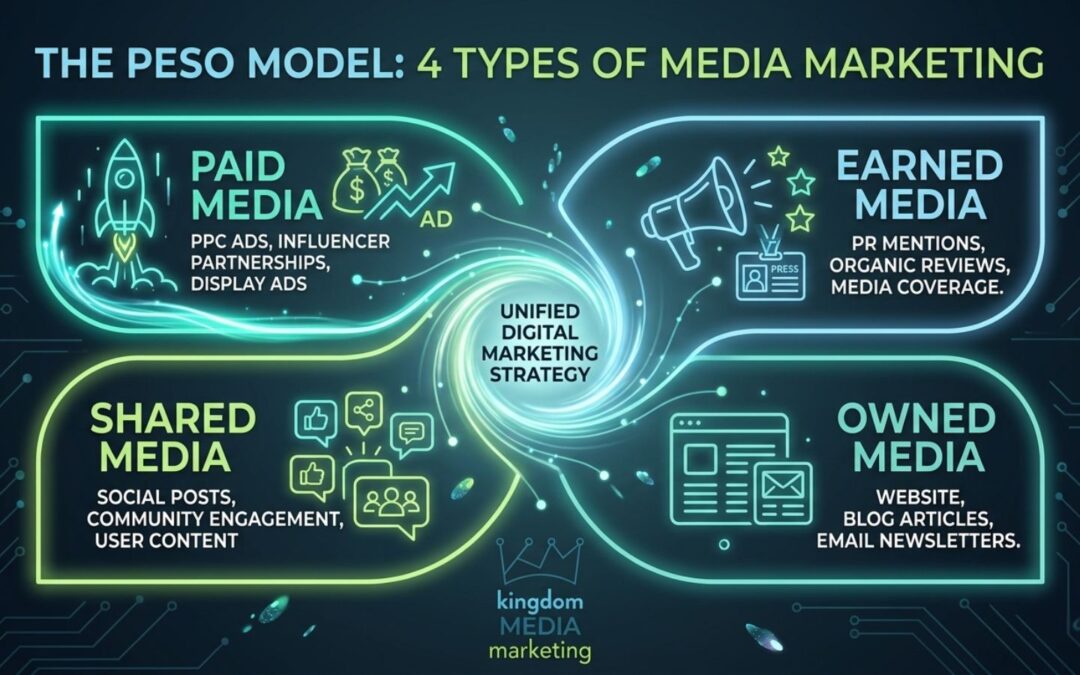
To cut through the confusion, experienced marketing teams rely on a structured framework known as the PESO model. This model organizes your marketing efforts into 4 distinct types of media: Paid, Earned, Shared, and Owned.
Here is a practical breakdown from the team at kingdomMEDIA marketing on how these four pillars function and how to leverage them for sustainable business growth.
1. Paid Media (The Growth Accelerator)
When you need to scale quickly, target a highly specific demographic, or guarantee immediate visibility, paid media is the tool of choice. This encompasses any marketing effort that requires a direct financial investment to secure ad space or distribution.
- Examples: Google Pay-Per-Click (PPC) search ads, sponsored social media updates, display advertising, retargeting campaigns, streaming/ctv ads and paid influencer partnerships.
- Why it matters: Paid media provides instant momentum. While organic SEO and community building require time to mature, paid campaigns can place your brand at the top of search results and in front of ideal buyers overnight.
2. Earned Media (The Credibility Booster)
Earned media is the digital equivalent of traditional word-of-mouth. It refers to publicity, mentions, or recognition generated entirely by external parties, such as journalists, customers, or industry bloggers, without any direct payment from your brand.
- Examples: Unsolicited Google or Yelp reviews, public relations (PR) editorial coverage, organic social media tags, and industry awards.
- Why it matters: This is the highest-trust form of media available. Because consumers are inherently skeptical of advertising, they place immense value on unbiased, third-party validations of your products or services.
3. Shared Media (The Engagement Hub)
Commonly referred to as social media marketing, shared media includes any content you post on third-party channels. While you control the creative assets you upload, the platform itself, and the algorithm determining who actually sees your content, is controlled by a third party.
- Examples: Organic posts, short-form videos, and updates on LinkedIn, Instagram, TikTok, Facebook, and X.
- Why it matters: It is an essential tool for community building, brand awareness, and audience engagement. Shared media allows for real-time, two-way conversations with your target market, turning passive followers into active brand advocates.
4. Owned Media (Your Digital Foundation)
Owned media consists of any web property or content channel that your company completely controls. This is your brand’s digital home base. Unlike social media networks, you own the data, the hosting, and the audience distribution channel entirely.
- Examples: Your company website, blog posts, email newsletters, case studies, whitepapers, and landing pages.
- Why it matters: It builds long-term asset value and forms the core of your search engine optimization (SEO) strategy. High-quality owned media establishes your business as an industry authority and remains completely under your control regardless of market shifts.
Pro Tip from kingdomMEDIA marketing: Your primary digital objective should be to guide traffic away from “rented” spaces (like social media platforms) and funnel them toward your owned media, where you can capture leads and manage the customer relationship directly.
Balancing the PESO Framework
| Media Type | Control Level | Trust Level | Primary Purpose |
| Paid | High | Low | Reach & Lead Generation |
| Earned | Low | High | Credibility & Trust |
| Shared | Medium | Medium | Engagement & Community |
| Owned | High | Medium | Conversion & Authority |
A truly effective digital strategy doesn’t rely on just one pillar; it integrates all four to amplify results across the entire marketing funnel.
For example, you might publish an authoritative industry report on your website (Owned Media). Next, you share key takeaways and graphics across your social channels (Shared Media). To reach decision-makers outside your immediate follower base, you allocate a budget to boost those posts to a targeted demographic (Paid Media). Finally, an industry publication spots your data, finds it valuable, and features your insights in an editorial piece (Earned Media).
Build a Scalable Strategy
Balancing Paid, Earned, Shared, and Owned media takes clear metrics, careful coordination, and consistent execution.
If you are ready to streamline your digital approach and focus on measurable growth, the team at kingdomMEDIA marketing is here to help. Contact us today to map out an integrated strategy tailored to your specific business goals.