
If your business sends marketing messages to customers — especially text messages (SMS/MMS) — and you might do business with residents of Texas, there’s a change you absolutely need on your radar.
Texas Senate Bill 140 (SB 140) took effect on September 1, 2025, and it completely alters how the state treats text message marketing. What used to be a strategy many businesses took lightly is now squarely in the world of regulated communications under the Texas Business & Commerce Code, Chapter 302. (Vorys)
Let’s walk through what this means, step by step, without the legal mumbo-jumbo.
📲 Text Messages Are Now “Telephone Solicitation” in Texas
Before SB 140, Texas law mainly treated telemarketing calls — you know, sales calls by phone — as regulated. But now the definition of “telephone solicitation” has been expanded to include text messages and multimedia messages (MMS) that aim to promote a product, service, offer, or deal. (Texas Statutes)
That’s a big shift.
It means the same rules that applied to phone calls now apply to texts — and that comes with real legal and financial consequences.
💰 What It Costs to Comply
If your business sends marketing text messages to people in Texas — and you aren’t exempt (more on that later) — you generally must register with the Texas Secretary of State before you start texting Texans. (Texas Secretary of State)
Here’s what that looks like:
🧾 Registration Fee
- You must file a telephone solicitation registration form (Form 3401) with the Texas Secretary of State.
- The filing fee is $200 per year. (Texas Secretary of State)
🔒 Security Requirement
- You must provide a required security deposit — in most cases via a $10,000 surety bond.
That bond protects consumers if a business violates the rules. (Texas Secretary of State) - The $10,000 figure is not something you pay upfront out of pocket to the state — it’s a bond amount. Many surety companies charge a fraction of that (often around $100–$500 annually) as a premium, depending on your financial profile. (ZipBonds)
🧠 Renewal
- You must renew your registration and bond every year to stay compliant if you continue marketing to Texas phone numbers. (Texas Secretary of State)
🚨 What Happens if You Don’t Comply
Texas takes this seriously. If you violate the law, there are some potential consequences worth understanding:
🔹 Civil Penalties
The Texas Attorney General can seek penalties up to $5,000 per violation under state consumer protection statutes — and each text message can count as a separate violation. (Vorys)
🔹 Consumer Lawsuits
SB 140 also makes it easier for individual consumers to sue under the Texas Deceptive Trade Practices Act (DTPA). Those lawsuits can include:
- Statutory damages (e.g., hundreds or thousands per message)
- Treble damages (if conduct is found to be knowing or intentional)
- Attorney’s fees and court costs
There’s no cap on how many times someone can bring a claim — meaning multiple suits could be filed for ongoing marketing. (Losey)
🔹 Misdemeanor Risk
Failure to register itself may be treated as a class A misdemeanor under Texas law — which can bring fines and other penalties beyond civil liability. (Morgan Lewis)
In short: ignoring this law could get expensive fast.
🧠 “But What If I Only Send Consent-Based Messages?”
That’s a great question — and it’s exactly the gray area many businesses are trying to navigate.
Some legal discussions around SB 140 suggest that clearly consented SMS messages (i.e., where the person has explicitly opted in to receive texts) may not trigger the registration and bonding requirements under Chapter 302. (National Law Review)
That’s not a completely settled legal fact yet — and the safest path, if you’re unsure, is to treat your program as potentially subject to the requirements and confirm with legal counsel.
📍 Important Tip: Protect Your List Now
If you use a platform like Klaviyo for SMS marketing, there’s a helpful built-in tool you should know about.
Klaviyo has announced plans to automatically block messages to phone numbers with Texas area codes — essentially preventing texts from going to those numbers at all if you haven’t taken steps to comply with Texas law. This can help you avoid accidentally violating SB 140 while you sort out your compliance strategy. (OneSignal)
If you’re not using Klaviyo, or if you use another SMS platform, check whether it offers similar protections. Not all platforms will block Texas numbers by default, and accidentally sending texts into Texas without compliance could expose your business to risk.
👥 Who Might Be Exempt?
There are exemptions to the registration and bonding requirements — things like:
- Some publicly traded companies and their affiliates
- Financial institutions and insurance companies
- 501(c)(3) nonprofits
- Retail sellers that operate a brick-and-mortar location (under specific conditions)
- Businesses marketing to their own current or former customers (under certain continuity criteria) (OneSignal)
But exemptions aren’t automatic and can be tricky — it’s on your business to prove you qualify.
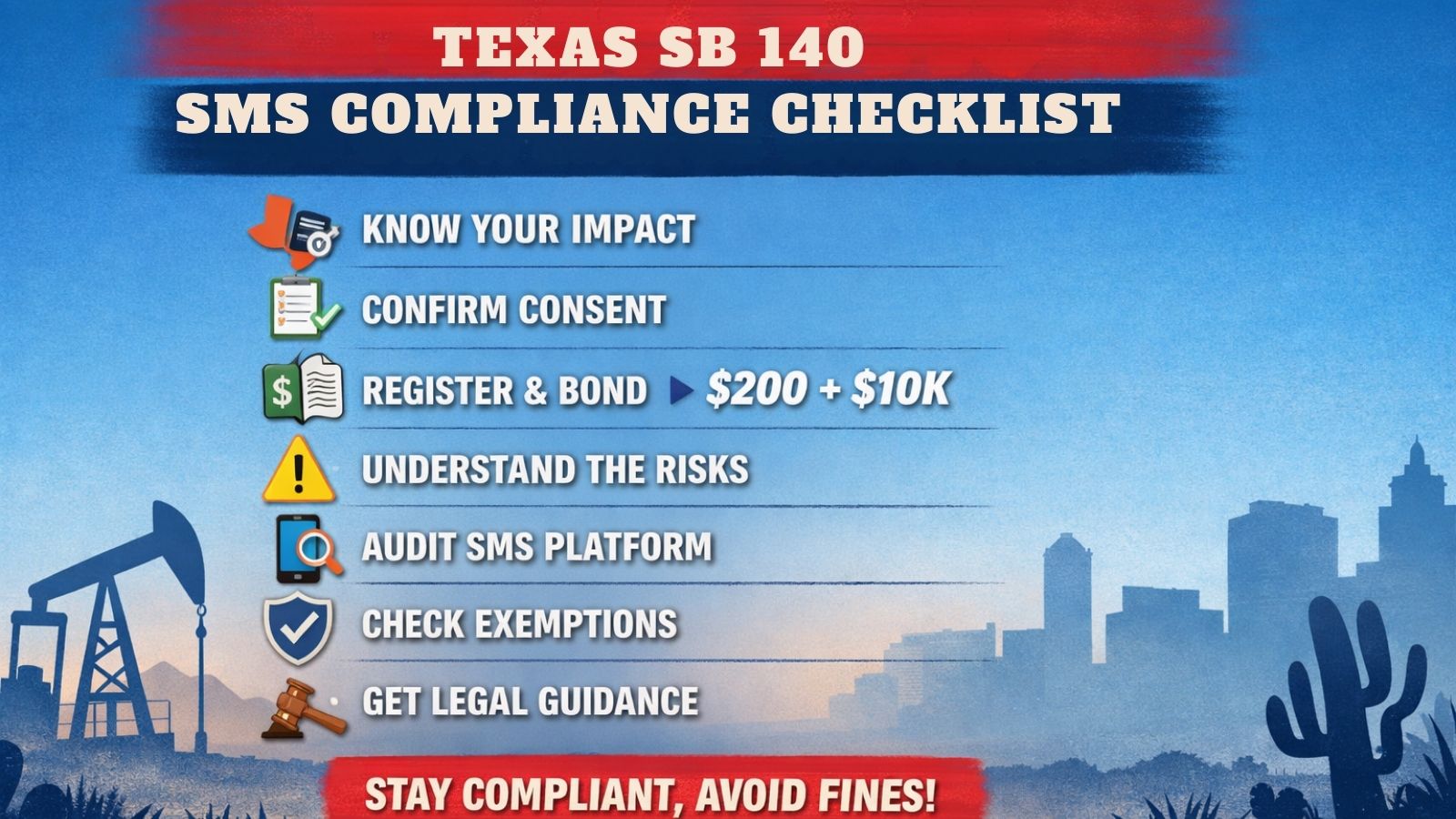
🛠 Practical Steps to Stay Safe
Here’s how to handle this proactively:
✅ Audit Your SMS Audience
Identify which numbers are Texas area codes — and segment or pause them until you’re compliant. (OneSignal)
✅ Confirm Consent
Make sure you have clear, documented opt-in from everyone on your list. (Kelley Drye & Warren LLP)
✅ Check Your SMS Platform
Ask if it will block Texas numbers or help you filter them out automatically.
✅ Evaluate Registration & Bonding
If your marketing reaches Texans and isn’t fully exempt, start the process with the Texas Secretary of State — filing the $200 registration and arranging the $10,000 bond (with a surety premium).
✅ Get Legal Advice
SMS marketing compliance is a mix of state and federal rules — getting expert guidance helps you avoid costly missteps.
🧠 Why It Matters
Texas just became one of the most aggressive states in the U.S. when it comes to regulating text message marketing. Unlike the federal rules (TCPA), which focus on consent and automated systems, SB 140 adds registration, bonding, and state-level enforcement layers. (GkLaw)
Ignoring this won’t make it go away — and if you see Texas on your customer list, you do need to pay attention.
But the good news is this: if you plan ahead and put the right systems in place, you can keep texting safely while you stay on the right side of the law.
🏁 Final Thoughts from kingdomMEDIA Marketing
Text message marketing is an amazing tool when it’s done right — it drives engagement, boosts conversions, and keeps customers close. But compliance matters, especially in states like Texas that are writing their own rules.
Whether you’re just starting an SMS strategy or already have one running, take a few minutes to check:
- Who you’re texting
- How you’re collecting consent
- Whether your platform blocks texts to Texas
- Whether you need to register and bond