
You’ve likely received a ton of calls lately telling you that your business isn’t showing up on voice search. Believe us, we get several calls about this, daily. It’s frustrating, and frankly, it gives digital marketing a bad name.
We wanted to educate you on this because there is a very fine line to walk here. While the people calling you are generally scammers using high-pressure tactics to sell you a “subscription” you don’t need, there is real validity to being listed on voice search.
The “scam” is the idea that you can pay a flat fee to a random caller to “activate” a voice search button. The “reality” is that voice search optimization is a strategic, ongoing process. Here is how you actually dominate the ears of your customers without falling for the phone scams.
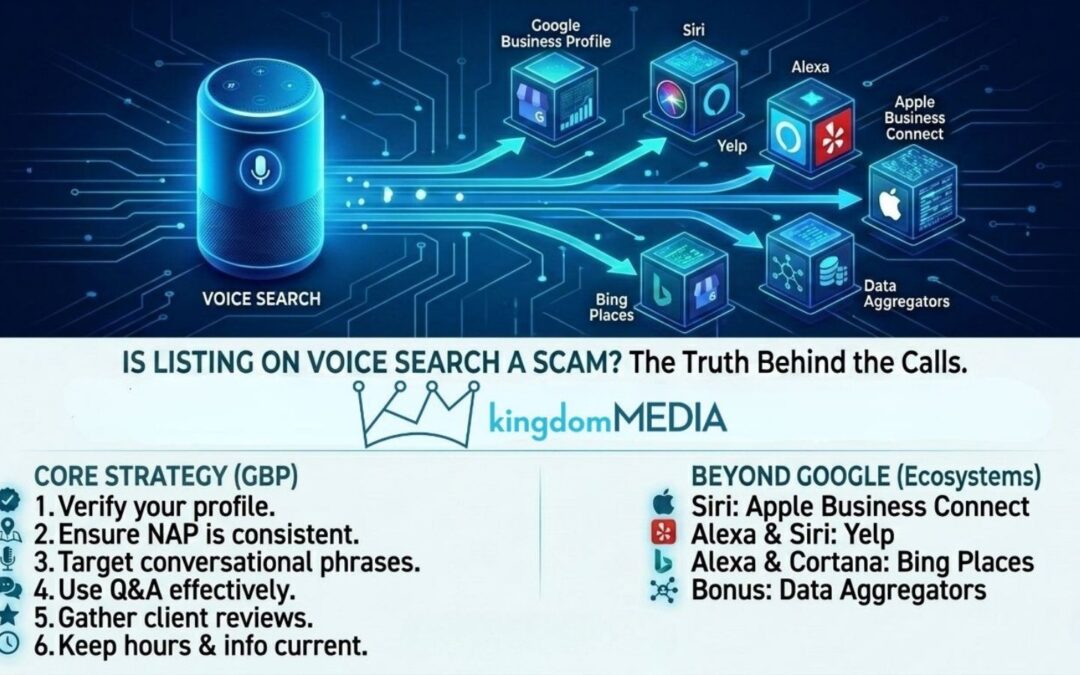
The Core Engine: Google Business Profile (GBP)
The foundation of voice search isn’t a secret code; it’s your Google Business Profile. This is the engine that powers the majority of “near me” voice queries.
- Claim and Verify Your Profile: This is the absolute core. Verifying your business proves to Google you are a legitimate entity; a strict requirement for voice assistants to recommend you in “zero-click” results.
- Lock Down NAP Consistency: Your Name, Address, and Phone number must be identical across your GBP, website, and local directories. If an AI assistant sees conflicting info, it won’t trust the data enough to read it out loud.
- Target Conversational Keywords: People talk to Siri differently than they type into a search bar. We focus on long-tail, conversational phrases. Your content should answer the Who, What, Where, When, Why, and How of your industry.
- Leverage the Q&A Section: Voice assistants love direct answers. We recommend proactively seeding your GBP with frequently asked questions and providing clear, conversational responses.
- Harvest and Showcase Reviews: When someone asks for the “best” marketing agency, voice tools look at star ratings. A systematic approach to collecting and responding to reviews signals to Google that you are active and trusted.
- Keep Information Hyper-Fresh: “Is kingdomMEDIA Marketing open right now?” If your hours aren’t updated for the holidays, you lose the lead. Use GBP Posts to keep your information current.
Beyond Google: The “Big Three” Ecosystems
Different voice assistants pull from different sources. To ensure your brand dominates the board, you have to look beyond just Google.
| Platform | Who it Feeds | Why it Matters |
| Apple Business Connect | Siri (iPhone, CarPlay, HomePod) | Siri doesn’t use Google data; it pulls directly from Apple Maps. If you aren’t claimed here, you don’t exist to iPhone users. |
| Yelp | Alexa & Siri | When users ask for the “best” or “top-rated” businesses, Alexa and Siri lean heavily on Yelp’s review ecosystem. |
| Bing Places | Alexa & Cortana | Alexa uses Bing for broad web queries. By syncing your GBP to Bing Places, you cover the Microsoft and Amazon ecosystems instantly. |
The “Bonus” Strategy: Data Aggregators
Voice algorithms require “trust signals.” By being listed correctly on major data aggregators (like Foursquare or Data Axle), you push your info to hundreds of smaller directories. This massive web of consistent data tells AI assistants that your business is the “authority” it should recommend.
The Bottom Line
If a telemarketer calls you claiming your “Voice Search Listing has expired or is not visible,” hang up. It’s a scam.
However, if you want to ensure that when a potential client asks their phone for a service you provide, your name is the one spoken aloud. That requires a strategy. At kingdomMEDIA marketing, we don’t just “list” you; we build the digital authority that makes voice assistants trust you.
Ready to actually be heard? Let’s talk.